With the introduction of OLED screens to the iPhone X, more and more people are requesting night themes in their favourite apps to take advantage of the true blacks on OLED screens, to save battery, and to make it easier on the eyes in some cases. But should you add this option to your app?
Don't confuse choice with convenience.
If you ask any user if they'd want the option of night mode in your app, they would say yes. As consumers we think we need more choices. It sounds very logical. The more choices I have, the more likely I am to choose something that suits me and makes me happy. But does more choice actually make users happier? In the TED Talk, The Art of Choosing, Sheena Iyengar explains how that might not actually be true.
Just because users are asking for options, doesn't mean they're going to start using them or that it's the right choice for them. Depending on the type of content that you provide to your users, a night mode might actually hurt their engagement.
You have to ask yourself why you're thinking about a night mode. If you're doing it solely to give your users options, then please, do yourself and your users a favour and stop. There are many downsides to having a night mode that you have to consider and be OK with before adding it to your app.
A night mode creates inconsistency within your app. It's already hard enough to keep your apps consistent with iOS and Android, and if you have a website having that be consistent with everything too. Why would you go out of your way to make it even more difficult for yourself?
A night mode might reduce your users' engagement with your app. Your users are the reason that you have created your app. They have been using your app and are used to it. If you have good information architecture and user experience, they might even be using your app with muscle memory. These users are your friends. They have already memorized your app's hierarchy and are using affordances and clues in your app to navigate it fluently. Introducing a dark mode would change all of that. Now they have to re-learn your app. Even though everything is in the same place, they have to re-learn the affordances and clues and repeat the process of getting used to it all over again, and this risks alienating your users. They might see the dark mode and think that's a good choice for them and turn it on, but the next time they open your app they won't know how to navigate it and it will feel strange.
Designing a night mode for an app is no easy task either. You might think that it's just as easy as flipping the background and text colours, but there's actually a lot to consider. If there are photos in your app, are they going to look their best in dark mode? On each given page, is the right content being highlighted when the colours are switched? Does users' attention still flow the same way it did in the regular mode? How does the settings page look? Should the settings page also be switched to dark mode?
What if my users have sensitive eyes and can't handle bright lights? Or it's very hard for them to read black on white due to dyslexia? Both iOS and Android have very thorough accessibility features to accommodate the whole experience for them. Having those settings on an app-by-app basis would be confusing and inconsistent.
OK. So there are many reasons why someone shouldn't add a night mode to their app. But is there a good time to add a night mode? Yes.
It all depends on the context — the type of content or service you are providing your users and the context in which the users use your app. The main complaint around the lack of night mode is prolonged reading at night in a dark environment, mostly in bed or while in a car.
If your app is a game, then don't bother.
If it's a productivity app, it's still a very hard no as changing the colour of the tools and the layout in an app that users depend heavily on might confuse them.
If your app is related to messaging, then it's best to optimize for the Smart Invert feature and let the user control the dark mode from the accessibility section in settings if they wish.
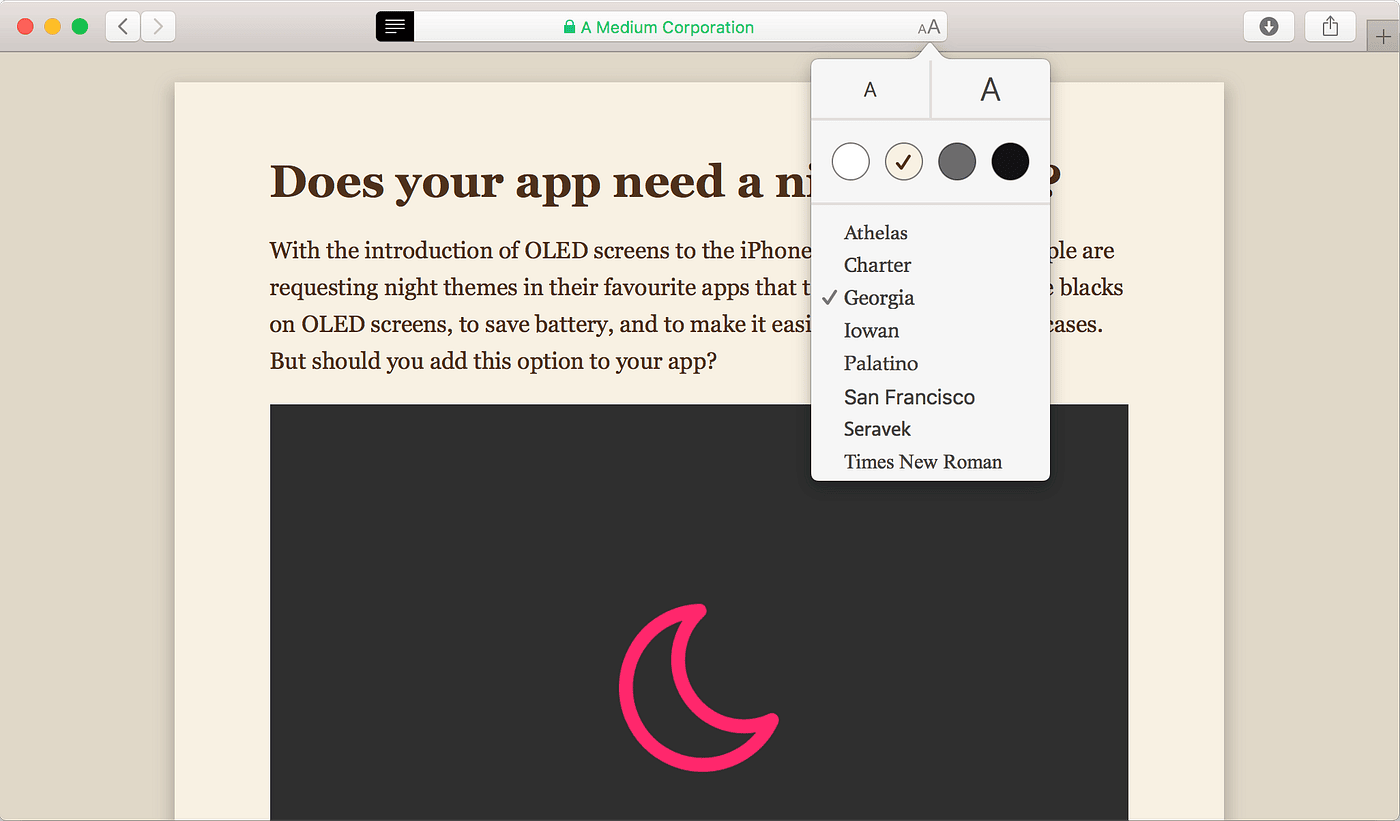
If your app focuses on reading, then it's a good idea to provide options for your users to adjust the reading environment to their comfort. A great example of this is the Reader mode in Safari.
If your app is related to driving, like Google Maps or Podcasts, and might stay open while a user is behind the wheel, it's a good idea to add automatic night mode so that it won't distract the users while they're behind the wheel.
I've seen a lot of confusion and frustration from users and designers surrounding night mode and if it should be a system-wide feature or not. I hope this article made it a bit clearer if you should or shouldn't add a night mode to your app. Happy designing!